The Grasping Hands of Primates are an Adaptation to Life in the Trees

There was the first spring, when the roses bloomed in February – or perhaps it was even January – I have forgotten. In the front of the garden lay the double pink and the yellow roses, standing stalwart against the North wind. A late February ice storm beat them back to the ground; I almost thought they were lost, but no, roses are strong.

The second spring came similarly; why were all the storms so strong now, as if sending us a message from on high, something we were supposed to notice? There was the hail storm that felt as if someone was pouring golf-ball size hail from the roof amidst a green sky like one of a tornado. The tornado came later, and we all learned that the scariest parts of tornados is that they are invisibly powerful as they tear off your roof.

My roof remained unscathed; my friend sent me a photo of the tornado traveling just above our house on its way out of town where it wrecked a fine line of homes and barns in a path of destruction.

The changes happen slowly; perhaps we should have known this. I should have known this, as an armchair scientist and teacher of critical thinking, discernment. How could it be fast like in so many stories? It was slow.

I often wonder about princesses in carriages; gazing out the windows at the landscape. What did they think about? Were they in conflict with their material possessions in contrast with the lives of their people? My doctor said to me two weeks ago: we all had gotten way too used to all the Amazon, click-a-button and have it shit, it was time for a change.

A change is here; I feel it settling around me and I am trying to choose how to respond. I keep planting trees. I have planted six so far. My husband said last night, “I will be working in the garden on the day they blow the world apart”.

Could it be? Every day I go into a classroom and turn on lights, log into the internet, kids come in and go and get breakfast and later, lunch. We walk up a green hillside dotted with dandelions and if we have time, go into the woods to walk the trails. Children are friends, get mad at each other, stare into their phone screens, cry, laugh, and make fun of me. I love it. The children everywhere are the best part of the gig. I think every day about children in Israel, Gaza, Yemen, Ukraine, Russia, the Congo, the Sudan, etc. and I wonder do they get to walk into a classroom?

I remember teaching in Philly 12 years ago and how surprised I was at the world within the world I was then a part of. The other day there was an article about that same neighborhood in the New York Times and it made me so sad. Why? I think because I know now that it is worse than it was when I was there, and that fact is so shocking to me. I remember walking to the Dominican restaurant down the block to get lunch or to the little shops under the El to get candy or cookies for kids. There were no homeless people sick from drugs then; there were simply drug markets selling the drugs that would then populate all the blocks, all the corners. I remember taking a photo of a vacant lot with a hurricane fence, overgrown with weeds and wondering why there were no trees there.

For me, peace is coming in tiny moments and I have to actively pursue them. Dusting furniture, looking at the ocean, cooking dinner, planting a tree, refilling a bird feeder; all are tiny moments that are expanding into a greater peace. I look at the pine boughs in late afternoon sun and the way clouds look early in the morning and remember that we are all so tiny in this cosmos, and it will continue long after we are gone, whether through simple mortality or grave human error.

During the eclipse, I watched with awe the power of the Sun, and thought, without that one thing, all is lost! How amazing. We used to think that we were so powerful, before. Now we understand that nothing is certain, clear, or real. Perhaps it is time to jump into the unknown? Perhaps it is time to recognize that our hands are empty, but when we reach out to grasp another, the grasp and the hand are real.

Good night.

Waiting

Bruegel_1565_Winter-scene-with-a-bird-trap_WIK

Pieter Bruegel the Elder – A Winter Scene, 1562

What do I think of when I am lying there?: on my stomach, propped up on my elbows, leafing through art books on Toulouse Lautrec and Pieter Bruegel and Peter Beard; gazing upon the paintings in the collection of the Mauritshuis Museum.

Mad_meg

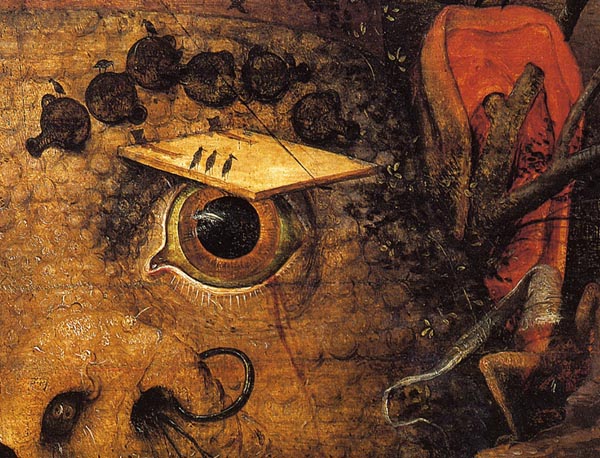
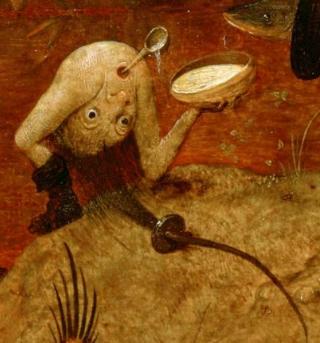
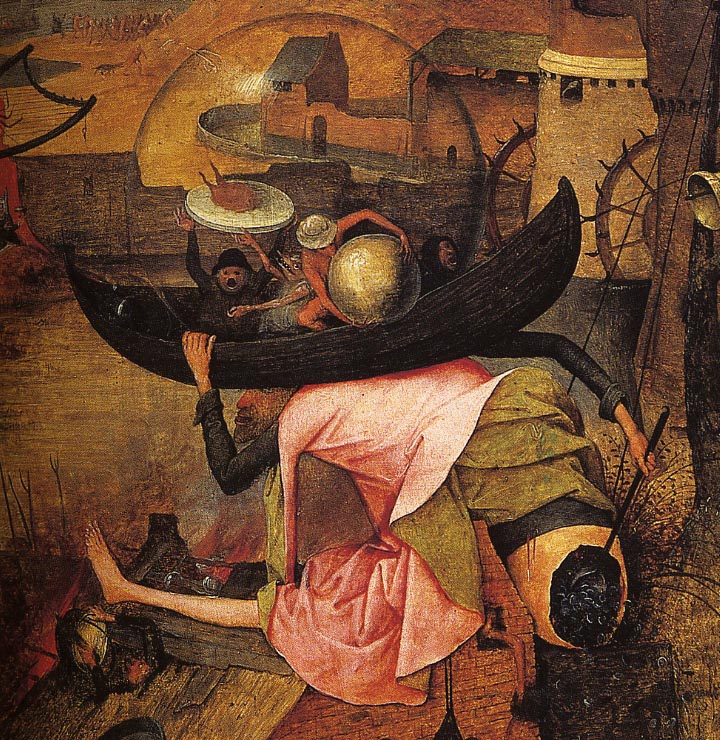
Dulle Griet by Pieter Bruegel the Elder

Pressed into the floor, feeling the coarse plastic fibers of commercial carpet dig into my elbows, through the fabric of my light shirt, I catch myself looking around. Behind me is a pool table, under which stand two polar bears, staring out at me. Above me are deeply pocked marks of pool cues’ chalk, all over the ceiling. To my left are giraffes and hyenas, and up above the window, the skeleton of a sea turtle, many years gone from this world. To my right is my dearest friend here, lost in his own thoughts.

Before me is an off-white enameled Jotul wood stove, with a front window already stained with soot. Through the soot shadow, one can depict the licking of bright orange flames made amber as they filter through the dirty shade. The flames grow and gather, spewing up and across the ceiling of the stove, recirculating.

img645 web

I am thinking about birds’ wings and the lips of Nepenthes plants. I am thinking about patches of snow on the surface of Little Long Pond, and of playing Pac Man on the table consoles at Pizza Hut in the ’80s. I am thinking about the tea that I am drinking, about artificial, non-dairy creamer: the stuff you can light on fire if you sprinkle it onto a candle’s flame. I am thinking about scent, about wood shavings, about ice melting, about the songs of the birds that just recently reappeared.

I am thinking about change.

Mad-Meg-by-Pieter-Bruegel-I-PARTIAL-butthead

We all know that birds’ bones are hollow so that their bodies and wings are lighter than ours: this is one of the reasons that they can fly and we are glued to the Earth. Each morning I watch five crows flit around from tree to tree along my street. They break into peoples’ garbage seeking treasure. They yammer at the the doves and the blue jays yammer back at them. They swoop and dive, and turn their heads to look at each other, and to me, as I stare at them. They pretend to be scared of me, when I know better. They were here before me.

Yesterday I went skating, maybe for the last time, and played an age-old game on ice skates. Pretending that the patches of snow were obstacles, were pools of lava, my friend and I skated round and round them, ever tightening our circles in between and through them, forming curly-cues and slashes and ellipses and circles in skate marks between the snow patches. The snow patches, large and small, close together and far apart, became deadly territory that would turn you into a ghost if you touched them, and provided fodder for chasing each other, not too quickly, between them in a game of ghost tag. Ghost tag, so much like Pac Man, making me think of the way the crust crunched at Pizza Hut when I was a child: how greasy it was, and how all the windows were made of diamond shaped stained glass in clear and red. How we sat at booths together but snuck off to play video games at those strangely stalwart video game tables.

img651 web

These are the thoughts that cross my mind in mid-winter, in February, as the ice and snow melt outside, again. I learned my lesson last week, when a short February thaw had me convinced I’d be in sundresses in no time, only to be blasted by a fierce winter storm once more.

After the snow came roaring through, again, a few days ago, my friend and I drove down to Jordan Pond to assess the likelihood of skating. As we clambered over a snowbank, carrying skates down the path to the water, we crossed another, larger snowbank and were hit, full force, full frontal with 55 mph gusts of blowing snow. Wind so fierce that it blew ice crystals into your eyes. Wind so strong you couldn’t even look into it. Wind so loud it howled around and through your ears. Wind so tough that we both laughed and walked back to the truck; recognizing when to go home is a skill one learns during winter in Maine.

Mad-Meg-by-Pieter-Bruegel-I-PARTIAL-butthead

Winter is drawing to a close: you can feel it in the air. There is a lightness to the sky, as if the sun is coming back. The birds are calling. The days are full of sunshine, when for so long, they have been so dark. There is a sadness in this: a loss. The darker times when all that is before you is you and your work, you and the tiny world that surrounds you, when the sun sets before 4 and all you can think to do is create; well that time is shifting and going away. The light is returning, flooding us with the recognition that soon, buds will burst open on tree limbs, grass will grow, crocus will appear in front of our eyes. Soon, the light will return and the sunsets will change, the water colour will, too, and people will return to this place that has been so quiet and lovely for so long. Flowers will grow, shoulders will be bared, times will change. People will change.

People already are changing: a nervousness is invading every cell of every person, causing each of us angst and anxiety, expressed in unique ways. Peoples’ eyes flit back and forth, as if they are watching for something. Some people draw back, into themselves, away from those that they have held dear during the darker months. Some people are planning, some people are counting down the days, some people are thankful for the retreat of the ice and snow.

Some people are waiting; listening for the ice to crack.

Mad-Meg-by-Pieter-Bruegel-I-PARTIAL-woman